How a Reclaimed Candle Company Teaches Kids Responsibility and Entrepreneurship

A handmade candle can start as an empty jam jar, a chipped teacup, or a forgotten tin from the back of a cabinet. For a child, that small object can become something much bigger: a lesson in follow-through, care, money, creativity, and respect for the planet.
Building a custom candle company with reclaimed containers gives kids a real project with real results. They have to collect materials, clean them, plan designs, track costs, make safe choices, and decide what to do when something goes wrong. The business can stay small, even just a family table at a local craft fair, but the lessons are large.
It also connects entrepreneurship to sustainability in a hands-on way. Instead of teaching recycling as an abstract idea, kids see how discarded materials can become useful, beautiful products people value.

Sustainability makes the business lesson more meaningful
Many kids understand recycling as something that happens after dinner, when cans and cardboard go into the bin. A reclaimed candle company brings that idea closer. It shows that waste is often a resource waiting for a second use.
When kids use reclaimed containers, they learn to ask better questions:
Can this jar be cleaned and reused?
Is this container safe for candle making?
How much waste can we avoid by using what already exists?
Would someone enjoy this more because it has a story?
That way of thinking matters in business. Entrepreneurship is not only about selling something. It is about solving a problem in a useful way. In this case, the problem is simple and familiar: homes, restaurants, and families throw away containers every week. A child-run candle project can rescue some of those containers and turn them into gifts, décor, or fundraiser items.
This also teaches kids that profit and responsibility can work together. They can create something people want while reducing waste. They can make decisions based on cost, quality, safety, and environmental impact. That balance is one of the most useful business lessons a kid can learn.
A reclaimed candle project also slows the process down in a good way. Buying brand-new containers is easy. Reusing containers requires inspection, cleaning, planning, and patience. Kids learn that responsible businesses do not skip the unglamorous steps.
The candle-making process teaches care from start to finish
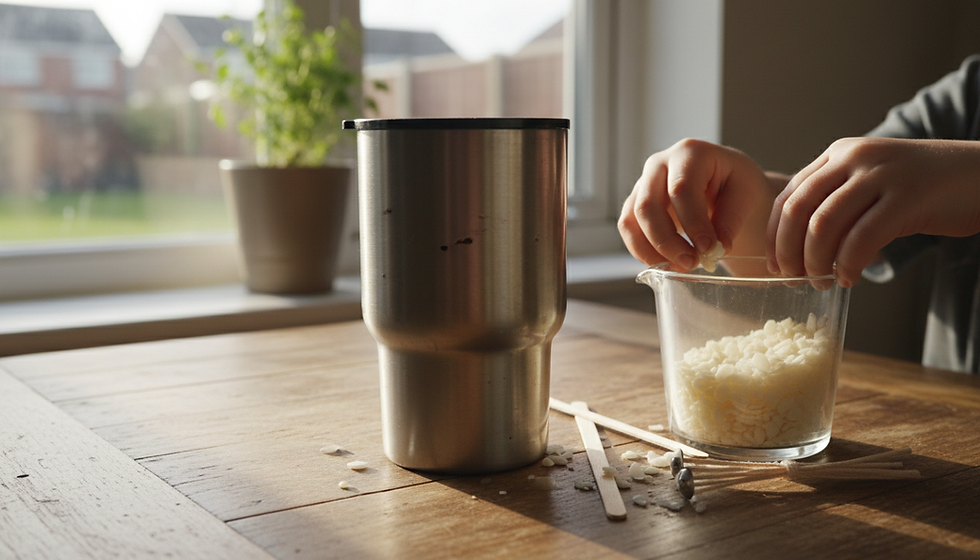
Candle making is a great project for kids because it has a clear beginning, middle, and end. It also requires adult supervision, especially when melting wax and handling hot materials. Children can take on many parts of the work, while adults handle or closely supervise the risky steps.
Here is a practical process families can follow.
Gather safe reclaimed containers
Start with containers that are sturdy, heat-resistant, and easy to clean. Good options may include:
Glass jam jars
Small mason jars
Ceramic mugs or teacups without cracks
Metal tins made for food or storage
Thick glass yogurt jars
Avoid thin glass, cracked ceramics, plastic containers, or anything with unknown coatings. If a container looks fragile, skip it. A child can help inspect each piece and sort it into “use,” “donate,” and “discard safely” piles.
This step teaches judgment. Kids learn that not every reclaimed item is ready for reuse, and safety matters more than saving every single object.
Clean and prepare each container
Containers should be washed well, labels removed, and sticky residue cleaned off. Dry them fully before use. Kids can help with soaking jars, peeling labels, scrubbing, and drying.
This is where responsibility becomes visible. A candle in a dirty jar does not feel special. Good preparation shows respect for the customer and the product.
Choose wax, wicks, and scents
Families can compare common candle supplies, such as soy wax, beeswax, cotton wicks, and fragrance oils made for candles. Kids can help choose scents and colors, but adults should confirm the materials are intended for candle making.
This is a chance to teach research and decision-making. The cheapest supply is not always the best choice. The prettiest scent may not work well in wax. Kids learn to read labels, ask questions, and test before making a larger batch.
Set up a safe workspace
A safe setup matters. Use a stable surface, keep paper towels and clutter away from heat, and make sure an adult manages hot wax. Kids can place wicks, line up containers, label batches, and record notes.
A simple notebook can include:
Date of the batch
Container type
Wax type
Wick size
Scent used
Cooling time
Notes on how the candle burned
That notebook turns candle making into a science and business lesson.
Pour, cool, and test
Adults should lead the pouring, while kids observe, time the cooling process, and check wick placement. Once candles cure, test one from each batch before selling or gifting the rest.
Testing teaches patience. A candle may look finished before it is ready. Kids learn that quality control protects the customer and the reputation of the business.
Package and label with care
Keep packaging simple and sustainable. Recycled paper tags, twine, and handwritten labels can work well. Labels should include basic safe-use reminders, such as burning within sight and keeping candles away from children, pets, and flammable items.
Kids can name scents, decorate tags, and write short notes about the reclaimed container. That story can become part of the product’s charm.

Kids learn business skills without it feeling like homework
A reclaimed candle company gives kids a reason to practice real skills. The learning feels useful because it connects to a product they can hold, improve, and share.
Budgeting becomes concrete
Budgeting can feel abstract until a child has to decide how many candles they can make with one bag of wax. A small candle business makes costs visible.
Kids can track:
Wax
Wicks
Fragrance oils
Labels and tags
Cleaning supplies
Craft fair fees, if any
Donation or savings goals
They can calculate the cost per candle with help. For example, if a batch costs $24 in supplies and makes 12 candles, each candle has $2 in supply costs before any packaging or fees. That simple math helps kids understand pricing, profit, and trade-offs.
It also teaches restraint. If they spend all their money on fancy scents, they may not have enough for wicks or labels. That lesson is much easier to absorb through a real project than a worksheet.
Planning becomes necessary
Candles take time. Containers must be collected, cleaned, poured, cooled, cured, labeled, and tested. Kids quickly learn that they cannot start the night before a sale and expect great results.
A simple production calendar helps them see the full process. It might include one day for cleaning jars, one day for pouring, one day for labeling, and one day for packing orders.
Planning also helps kids learn how to handle limits. If they only have 15 safe containers, they can only make 15 candles. That teaches inventory in a simple, natural way.
Teamwork becomes practical
A candle project gives everyone a role. One child might sort jars. Another might design tags. A parent might supervise hot wax. A sibling might help count supplies.
Teamwork works best when roles are clear:
Creative lead
Materials manager
Quality checker
Sales helper
Chooses scent names, colors, and tag designs
Counts jars, wicks, wax, and packaging
Looks for cracks, loose labels, and uneven wicks
Practices explaining the product politely
Rotating roles keeps the project fair. It also helps kids respect work they might not naturally choose. A child who loves decorating may discover that counting inventory matters just as much.
Problem-solving becomes part of the job
Something will go wrong. A wick may lean. A scent may be too strong. A label may fall off. A container may crack during cleaning.
That is not failure. It is the business lesson.
Kids learn to ask:
What happened?
Can we fix it safely?
How do we prevent it next time?
Should this candle be sold, kept, or remade?
These questions build accountability. They show kids that responsible entrepreneurs do not hide mistakes. They correct them.
Real young entrepreneurs show what kids can do
Not every child-run project becomes a national brand, and it does not have to. Success can mean earning money for a school trip, donating profits to an animal shelter, or learning how to talk to customers without fear.
Still, real examples help kids see what is possible.
Mikaila Ulmer, founder of Me & the Bees Lemonade, started selling lemonade as a child and connected her business to saving bees. Her story is not about candles, but it is a strong example of a young person linking a product to a cause. She showed that kids can build a business around values, not just sales.
Ryan Hickman, known for his recycling work, began collecting recyclables as a young child and turned that habit into a larger environmental effort. His example shows how a simple routine, repeated consistently, can grow into something meaningful.
Across the country, kids also sell handmade goods at farmers markets, school fairs, church bazaars, and neighborhood events. Some make soap, jewelry, baked goods, art, or candles. The most successful projects usually have a few things in common:
A clear product people understand
A child who can explain why they made it
Adult guidance in safety and money decisions
A manageable scope
A purpose beyond “make as much as possible”
A reclaimed candle company fits this pattern well. The product is useful. The story is easy to explain. The process teaches patience. The sustainability angle gives the business heart.

Parents can guide without taking over
The hardest part for many parents is finding the balance between helping and controlling. Kids need support, especially with hot wax, money, and customer interactions. They also need room to make age-appropriate decisions.
A good rule is simple: adults manage safety, kids manage ownership.
Start small enough to finish
Begin with a tiny batch, perhaps 6 to 10 candles. A small project lets kids experience the full cycle without getting overwhelmed. They can collect containers, make the candles, label them, test one, sell or gift the rest, and review what they learned.
Finishing matters. A completed small project builds more responsibility than a huge idea abandoned halfway through.
Let kids make real choices
Children are more invested when they make decisions. Let them choose scent names, tag colors, container pairings, or a cause to support. If two scent ideas seem reasonable, let them pick.
When a choice has real consequences, explain the trade-off. For example, “If we use the more expensive fragrance oil, each candle will cost more to make. Do you want to raise the price, make fewer candles, or choose a different scent?”
That kind of question teaches business thinking without lecturing.
Use money as a learning tool
Keep the money process clear. A simple cash box or spreadsheet can show income and expenses. Kids can divide earnings into categories such as:
Pay back supply costs
Save for the next batch
Donate a portion
Keep a small amount as profit
This helps kids see that revenue is not the same as profit. If they sell $60 worth of candles but spent $35 on supplies, the result is not $60 of spending money. That lesson is one of the most valuable parts of the whole experience.
Practice customer conversations
Kids may feel shy explaining their products. Practice at home first. They can learn to say:
“My candles are made in reclaimed jars. We clean and reuse containers so they do not go to waste.”
Or:
“This candle is lavender scented, and the container used to be a jam jar.”
These short explanations build confidence. They also help kids connect the sale to the mission behind the product.
Keep safety non-negotiable
Candle making involves heat, fragrance materials, and fire safety. Parents should supervise closely and handle tasks that are not age-appropriate.
Set firm rules:
No melting wax without an adult
No pouring hot wax alone
No selling untested candles
No using cracked or unsafe containers
No skipping warning labels or care instructions
Safety rules do not reduce ownership. They show kids that responsible businesses protect people.
Reflect after each batch
After the candles are made or sold, talk about what happened. Keep the conversation simple.
Ask:
What went well?
What was harder than expected?
Which candle was most popular?
Did our price make sense?
What should we change next time?
How much waste did we avoid?
Reflection turns activity into learning. It helps kids connect effort with results.

The biggest lesson is ownership
A reclaimed candle company is not only a craft project. It is a manageable way for kids to practice being responsible for something real.
They see that materials have value. They learn that customers deserve care. They find out that money must be tracked, time must be planned, and quality must be checked. They experience the pride of turning discarded containers into something useful.
The best part is that the project can grow with the child. A younger child might help wash jars and name scents. An older child might calculate pricing, plan inventory, and manage a small sales table. Over time, the same simple idea can teach deeper lessons.
The goal is not to build a perfect business. The goal is to raise kids who notice waste, solve problems, keep promises, work with others, and take pride in careful effort. A candle made in a reclaimed jar can burn for hours, but the responsibility learned from making it can last much longer.


Comments